
February 03, 2026
With border crossing figures hitting record highs, the consensus among retail and F&B stakeholders was that the territory had effectively hollowed out. For many, this sentiment translated into a conservative outlook for Q1, anticipating a slump in local demand.
However, a deep dive into granular mobility intelligence from the festive period (Dec 2025 – Jan 2026) reveals a more nuanced reality. The city wasn't empty; consumer behavior simply underwent a rapid structural shift.
Here is the data-driven truth about the "Hidden Market" that remained, and the strategic opportunities.
The "Hollow" Middle: Quantifying the Outbound Wave
Our analysis of outbound traffic at key border control points identified that the dominant departing segment was NW20.
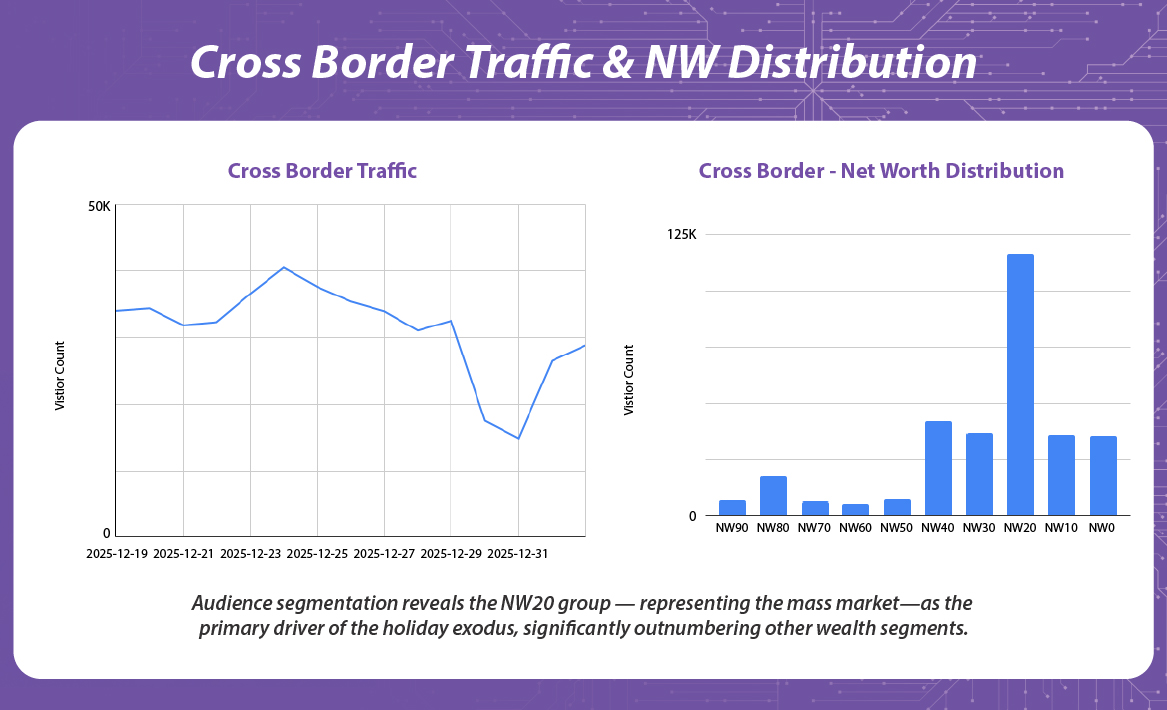
The Strategic Insight: The festive migration was volume-driven. It was the middle-income demographic capitalizing on the holiday window for cross-border or short-haul travel.
Market Impact: This explains the disproportionate impact observed in mass-market retail and Quick Service Restaurant sectors. The temporary dip in footfall was not a general market failure, but a displacement of the core volume consumer.
The "Hidden" Market: The Decentralization of Celebration
If the mass market left, who stayed? And more importantly, where did they go?
Mobility patterns during the New Year’s Eve Countdown signaled a clear bifurcation between tourist and local behavior. While inbound tourists consolidated around the traditional Harbourfront (CBD/TST), the domestic "Stayers" decentralized significantly towards East Kowloon.
The Data Anomaly: Contradicting traditional catchment models, Kwun Tong’s commercial (觀濱) and industrial zones recorded higher local footfall density on New Year's Eve than the West Kowloon Cultural District.
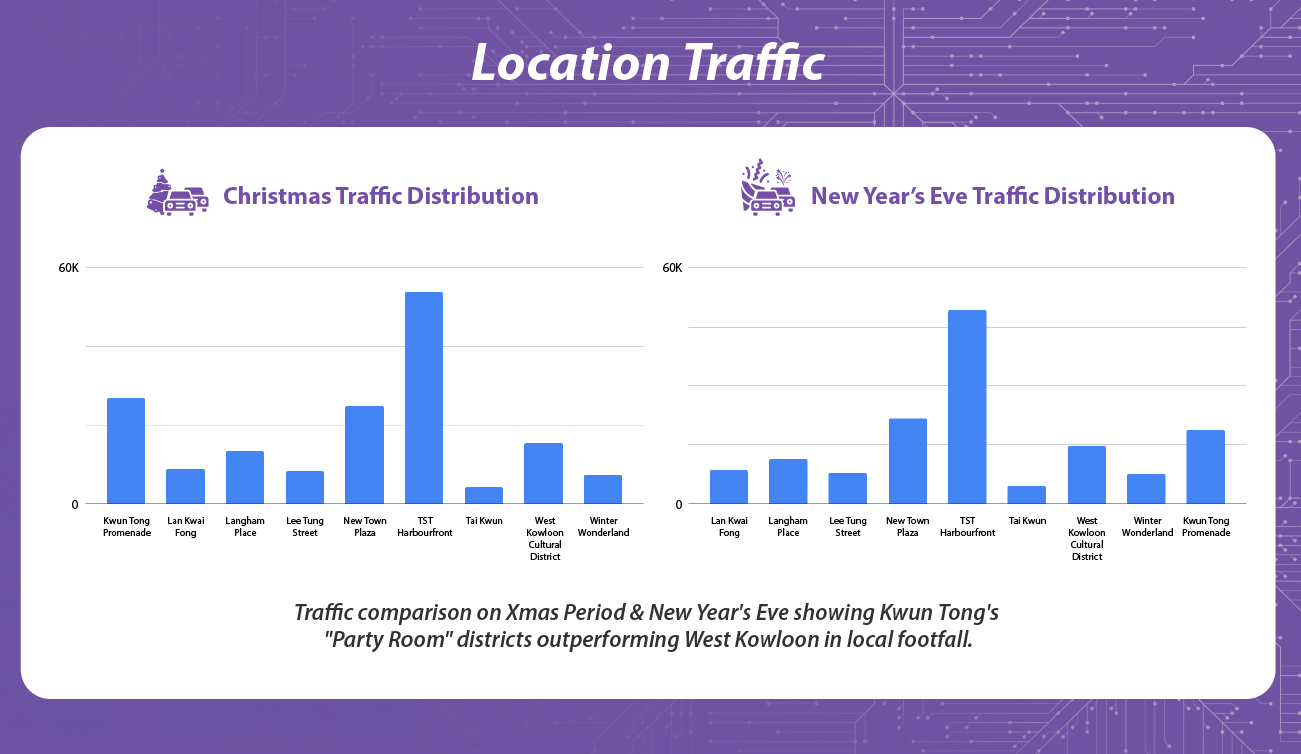
The Behavior Shift: This signals a pivot towards "Private Domain" consumption. The younger demographic is bypassing public mega-events in favor of controlled, private social environments (e.g., Party Rooms). This demographic is prioritizing privacy, cost-control, and intimacy over the "spectacle" of traditional tourist hubs.
Marketing Strategy: Targeting the New Persona & Habit
The data doesn't just tell us where people went; it tells us who they have become. To win in 2026, marketers must adapt their campaigns to this specific "Post-Exodus" profile:
- The Persona: The "Rational Returnee"
The NW20 mass market is back, but they are transitioning from "Holiday Mode" to "Daily Life Mode." Their share-of-wallet for luxury is low, but their need for routine is high.
- The Habit: "Group Commerce" (The Party Room Effect)
The surge in Party Room traffic proves that young consumers are bypassing public venues for private spaces. They are spending, but they are spending together in private.
Stop marketing to individuals; start marketing to "The Tribe." F&B and lifestyle brands must push high-ticket, shareable bundles (e.g., 6-person catering sets, party hardware, board games) that are designed specifically for O2O delivery to industrial party zones.
- The Channel: "Hyper-Local" Engagement
The decentralization to East Kowloon proves that the "Stayers" are living and transacting in their own neighborhoods, ignoring the tourist centers.
Shift your media spend from broad "City-Wide" awareness to "Community-First" conversion. Target the specific residential hubs (Kwun Tong, Sha Tin, Tsuen Wan) where the locals are physically present. If your ads are only in Tsim Sha Tsui, you are paying a premium for an audience that isn't there.
Key Takeaway
The festive "Outbound Wave" was not a loss of market potential, but a re-segmentation event. The domestic market has returned, but they are now a "Hybrid Consumer"—seeking value across the border for necessities, while reserving their local budget for social and experiential quality. Success in 2026 belongs to brands that can navigate this dual-speed consumption model: pivoting to private-domain engagement and localized catchment dominance.
Leveraging granular mobility data is no longer optional; contact us to see how we can map these new consumer journeys specifically for your brand.